
Warren Buffett's Blind Spot

Wait, what? How did he miss that!? – I still remember the chilling realization. I was researching yet another big investment success of Warren Buffett and its potential takeaways. My blog is full of them. This one was about purchasing car insurer GEICO. It started just like the other stories – some great anecdotes, lots of wisdom, brilliant success. Except for the last part. In recent years, GEICO has been losing ground. Due to a common mistake. It’s called Disruption.
Disruption Theory is a business insight that emerged from the technology industry. Prof. Clayton Christensen, who first introduced it in 1995, became the most famous Professor in Silicon Valley. Over there, they know all about Disruption by now. But Buffett has, famously, stayed away from tech companies. For decades.
I would never bash him for not investing in tech companies; critiques of the sort “the old man who invests in industrials has lost its relevance” have been sounded for decades, especially during periods such as the dot-com mania or the SaaS/Crypto boom of 2021, but eventually turned out to be false. When the tide went out, it was clear that Buffett’s Berkshire Hathaway had outperformed the various tech investors shortly dubbed “The Next Warren Buffett”.
Nevertheless.
Ignoring technology stocks is, I’m guessing, what led Warren Buffett to ignore business insights that emerged from tech. Even without directly investing in these businesses – nor even trying to grasp anything about how computers work – Buffett could have still gained useful lessons from learning the business stories around tech
The original article about Disruptive Technologies did elaborate, in great detail, on the innovation cycles of the hard-disk drive industry; but, you don’t need to know the first thing about hard-disks in order to understand the takeaway. And this same takeaway turned out to be relevant – in an unexpected way – for Buffett’s beloved GEICO.
What is this takeaway though?
It goes something like this: you’re a manager of a successful company. At the top of your industry. Your sales are growing. Your profitability is improving. That doesn’t surprise you; you run your organization well, through clear processes for allocating resources. You don’t just kick off projects and throw money on a whim; you talk to your customers, you understand their needs, you build financial models, and you make informed decisions.
Now, a new technology has emerged.
It seems cool, so your engineers play around with it. Prototyping. They make a pitch on how to make it into a product. But you ask to see the financial analysis first, and, well, as it turns out – it doesn’t look great. It’s not going to improve on the stuff your customers actually care about. Your engineers might enjoy building it, but your finance department is not going to like it. It would be irresponsible to pursue it. So you decide to abandon the project. You tell your engineers to keep their focus on your mainstream product, in order to stay ahead of competition. You’re not going to let shiny new technologies distract you from keeping your dominant position in the market. That’s why your shareholders pay you the big bucks.
This is called “The Innovator’s Dilemma”.
Therein lies the paradox. Because what looks like the right thing to do, is actually the irresponsible thing to do; and what looks like a reckless decision, is actually the right one to make.
Disruptive technologies have this tricky characteristic where they start at an inferior performance point compared to the established products, but progress along a steeper improvement trajectory. They don’t appear like a real threat for a long time; but by the time the new technology becomes a threat, it’s already too late for the incumbent to catch up.
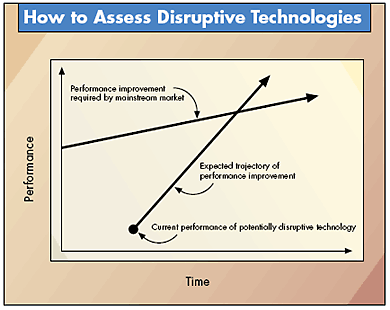
This is how successful companies become victims of their own succssess.
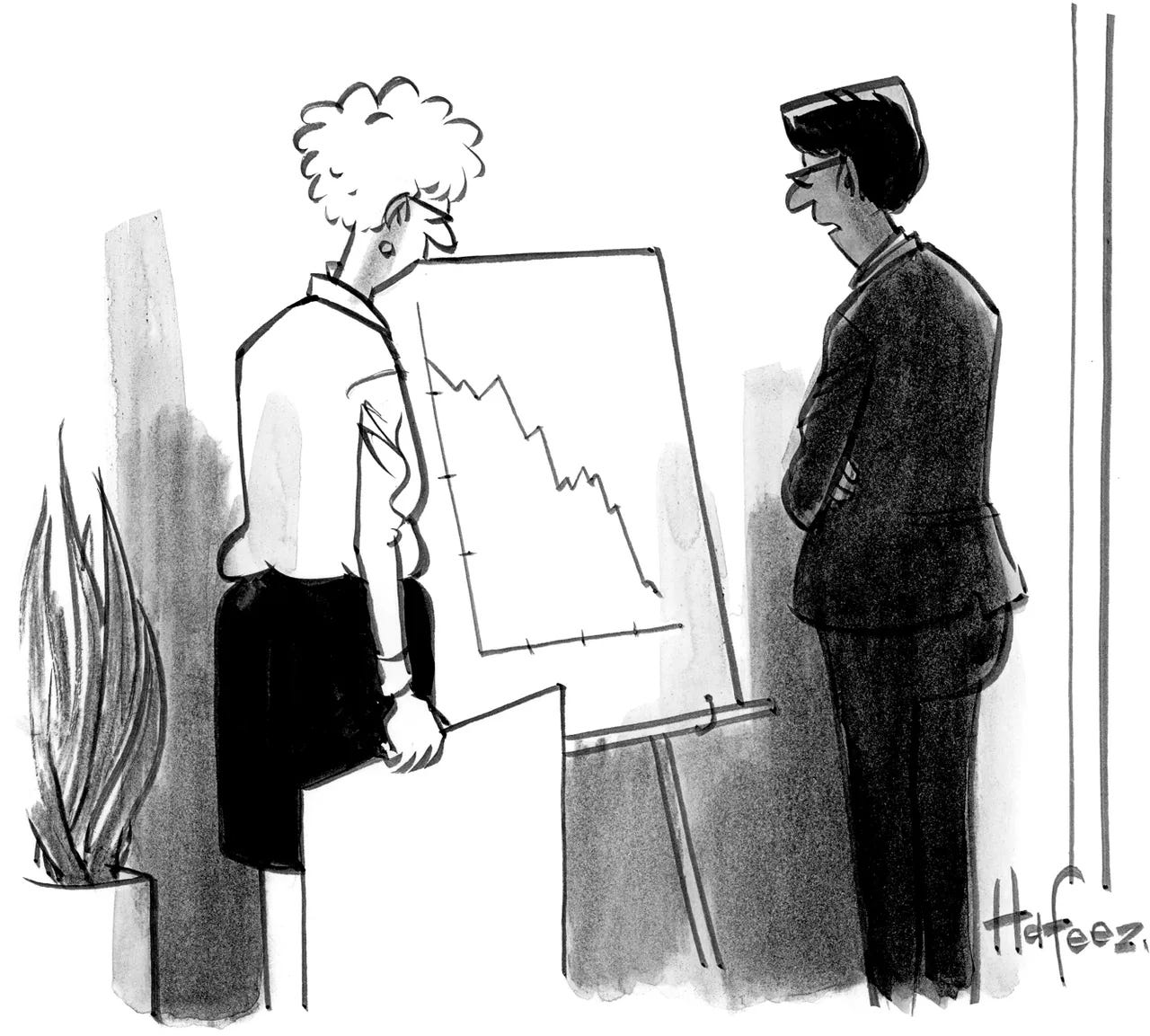
Not because they started slacking around, but quite the opposite – because they were being responsible and analytical and did the right thing. Yes, it can be very disheartening. A recent New Yorker cartoon did a great job describing it: I don’t get it, we had all these meetings.
What does this have to do with GEICO? Well, after Buffett had bought the company in 1996, and backed its rise as a dominant leader in the car insurance market, he probably didn’t expect GEICO to become a victim of its own success.
In 2012, a few years after Progressive – an also-ran car insurer – started installing devices that track drivers’ behavior – known as telematics – and adjust the cost of insurance accordingly, Buffett was asked why GEICO wasn’t doing it. He explained that they were aware of telematics, however dismissed it as an insignificant experiment. The economics are not going to work.
For several years, he was right. Ignoring usage-based insurance seemed like the correct decision. Progressive was spending far more than GEICO on R&D, while demonstrating worst loss ratios. GEICO’s underwriting remained superior, AND more profitable.
Until it wasn’t.
By 2019, Progressive demonstrated better loss ratios than GEICO, and surpassed their market share a few years later. Ajit Jain, Buffett’s insurance deputy, admitted that Progressive has taken the lead, but vowed to catch up. GEICO did introduce their own telematics product, only to realize that it isn’t going to be this simple. In 2023, four years later, Jain reported that they are still behind due to technical complexities; it turns out that telematics necessitated a major refactor of GEICO’s underwriting systems.
Telematics for car insurance is just one case where Buffett suffered a disruption blind spot. What could he have done differently here? Well, Christensen’s recommendation is to experiment with new and potentially disruptive technologies via small and independent teams. This is very intuitive for Sillicon Valley companies. GEICO could have created a small team to experiment with usage-based insurance – even without a spreadsheet to justify it! – around the same time as Progressive. That separate team may have a chance to beat Progressive, and protect GEICO’s lead.
Building a telematics product in 2012 might have seemed like a waste of money for GEICO, but perhaps they could have viewed it as an insurance against disruption. Insurance is something Buffett understands very well. The missing piece was understanding Disruption.
That’s not to diminish Buffett’s incredible track record.
He is probably the most successful and intelligent investor in human history. In fact, Buffett built the only non-tech trillion dollar company in the US stock market.
One can only imagine how much more successful Berkshire Hathaway could have been, had Buffett incorporated Disruption Theory into his brilliant business analysis mental model.
You got my attention with 'Buffett missed something?" ... beautifully and astutely laid out, Matan. Your message is so pertinent. 'Don't get complacent.' Always look over your shoulder (like how I did that?! aka your blind-spot title!!
By the way, you tickled my brain with your driving/car/road-race analogies and metaphors sprinkled through out - also ran; blind spot; keep your focus ahead etc. Thanks for a different perspective on Buffett.