Microsoft Excel remained the world's most popular programming language throughout the Cloud and Mobile eras; with AI, however, English may assume that role, rendering spreadsheet software obsolete.
There is something very special, and very historically different, that takes place when you have one computer and one person.
This is Steve Jobs, all the way back in 1980, talking about personal computers; charismatic as Jobs already was at the age of 25, it was hard to listen to him and imagine the mainframe becoming obsolete, or IBM reaching the edge of bankruptcy. Yet, that’s exactly what happened just over a decade later.
Similarly, it might be hard to look at Claude Code and imagine the end of Microsoft Excel, but allow me to model that scenario.
VisiCalc and the Personal Computer
How many of you use VisiCalc?
Steve Jobs asked during that 1980 talk, after sharing his mental model for computers. At age 25, this might be the earliest footage of Jobs introducing his bicycle for the mind analogy: many species ranked higher than “Man” on a Scientific American study of energy efficiency in transportation, but “Man with Bicycle” ranked at the top. Human beings build tools to amplify their inherent abilities, Jobs concluded, and a computer is a bicycle for the mind. He then went on to discuss VisiCalc, the first electronic spreadsheet program, and the killer app that made the Apple II sales skyrocket:
At Apple, every secretary now has an Apple on his or her desk […] and they’re doing a tremendous amount of financial modeling on the thing.
As an example, I have to keep a budget for about 40-50 people, and by the 10th of every month, my secretary has got all the information from accounting, put it into the VisiCalc model, given me the actuals vs. forecast and all the variances, etc. etc.
And we’re asking what-if questions on a daily basis. I can say … ‘What happens if I fire 5 more people this month? What’s that going to do to the budget?’ [snapping finger] An hour late I know. It’s incredible!
It certainly was incredible, yet hard to predict in advance: Dan Bricklin was initially warned by his Harvard Business School professor that the market was well served by financial modeling tools on time-sharing mainframe-based systems. He, fortunately, ignored the feedback and went on to launch VisiCalc in 1979, Largely thanks to this tailwind, Apple went public a year later in a $1.8B IPO (the biggest capital raise since the Ford Motor Company in 1956.)
Jobs explained what made VisiCalc, and the PC in general, succeed beyond expectations:
[…] Our whole philosophical base is founded on one principle […] There is something very special, and very historically different, that takes place when you have one computer and one person. Very different than if you have ten people and one computer.
Many use cases were unlocked once individuals had their own electronic blackboards — ones that weren’t possible back when time-sharing terminals were strictly allocated for financial modeling at large institutions. An example Jobs mentioned was a Nebraska farmer analyzing soil samples to optimize fertilizers. What got Jobs most excited, however, was seeing young children becoming proficient at computers. “They’re growing up with this thing.”
Microsoft Excel and the Graphical User Interface
But the bicycle for the mind vision wasn’t done with VisiCalc, as Jobs went on to describe:
Right now if you buy a computer system and you want to solve one of your problems, we immediately throw a big problem, right in between you and your problem, which is learning how to use the computer. Substantial problem to overcome. Once you overcome that, it’s a phenomenal tool. But there is a barrier to overcome that problem. What we’ve been trying to do [...] is to remove that barrier. So someone can buy a computer system that knows nothing about it, and directly attack their problem without learning how to program a computer.
Jobs was hinting at the Graphical User Interface (GUI), an invention that had obsessed him ever since he witnessed it at Xerox PARC; “Why aren’t you doing anything with this? This is the greatest thing. This is it! You’re sitting on a gold mine!” was his response. By the time he gave that 1980 talk, Jobs was already doing something about this: he was leading a team of Apple engineers building a GUI-based computer1.
In 1984, Steve Jobs unveiled the Macintosh, which was the first computer Microsoft Excel was built to run on2 when it was released in September 19853. While VisiCalc was long gone at this point, the spreadsheet market was led by Quattro Pro (the one I first used, as a child who “grew up with the thing”) and Lotus 1-2-3. Microsoft Excel, however, was natively built for the GUI, and the fastest to take advantage of the new paradigm. Once Microsoft launched their own GUI-based operating system4, Excel became the most popular spreadsheet application for Windows, and rode on its growth into dominating the spreadsheet market by the early 1990s.
This 1990 ad for Excel is fascinating to watch in hindsight:
Take a minute to observe what kind of features were considered mind blowing 35 years ago: auto-fill (dragging a few numbers into a whole table), real-time recalculation (the sum of a row as values change), or moving a table around the sheet.
While it feels so obvious and underwhelming today, the idea of building a whole spreadsheet in 60 seconds – while in the elevator on the way to the meeting – was considered a miracle in 1990. People used to spend an entire weekend on that.
Excel has done a phenomenal job educating hundreds of millions of people about the power of software. Startups are taking advantage of this newly data-literate user base and carving out individual applications, replacing Excel with dedicated workflow that’s optimized for a particular function.
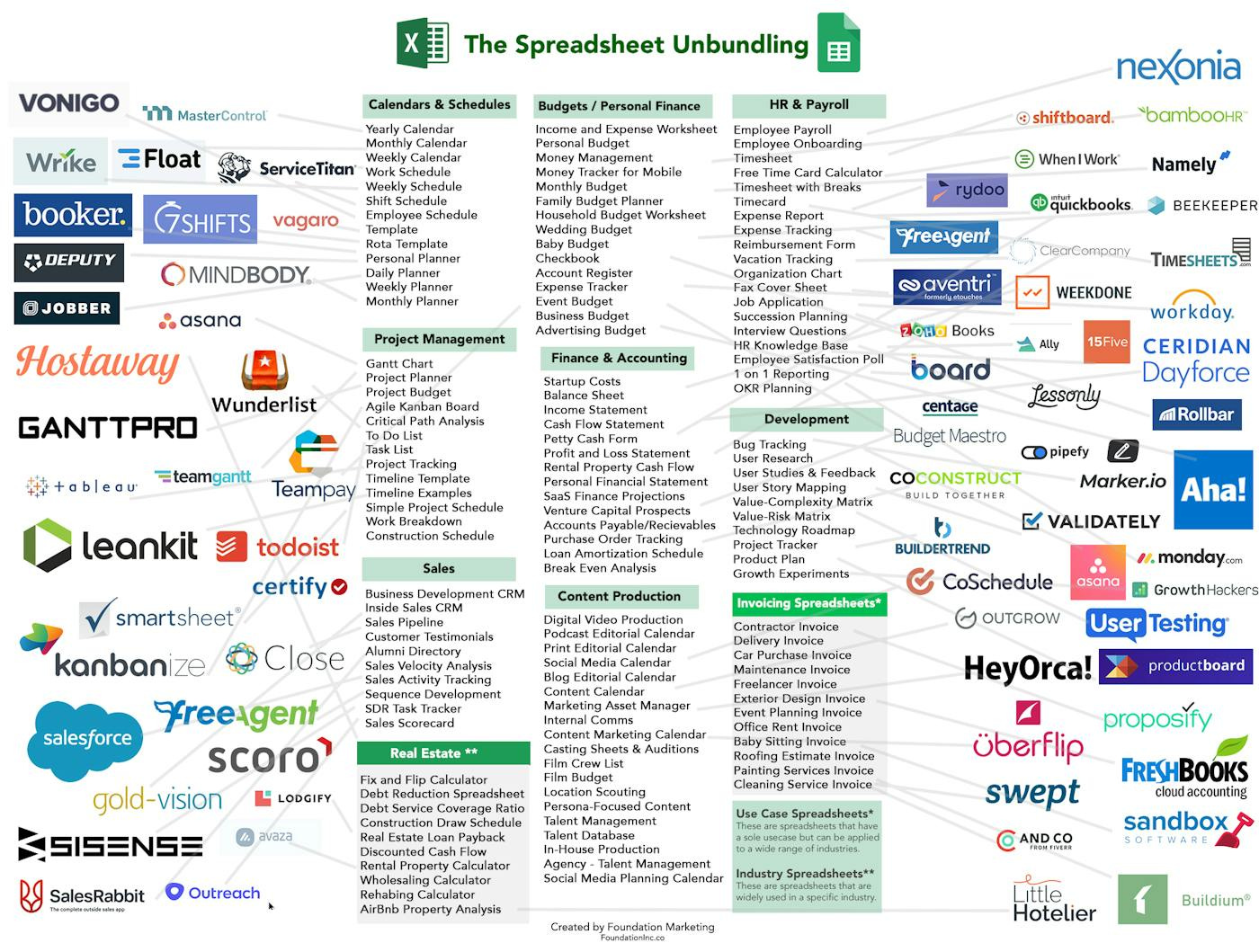
In his 2021 Excel Never Dies article, Packy McCormick pointed out that this amounts to hundreds of billions of dollars in market cap; Salesforce alone is worth roughly $200B, even after the recent SaaS panic:
Salesforce is a good example of how it works: people were keeping track of their sales leads in Excel spreadsheets, which works but isn’t ideal, so Benioff and Co decided to build dedicated CRM software that does a lot of specific things a user can’t easily do in a spreadsheet.
CRM software is easy to grok because it’s essentially one database-looking thing to another, but practically any software that is built to handle data that isn’t super long text (which is unbundling Google Docs) is unbundling Excel. That’s almost every B2B software you know and love. Tunguz didn’t even try to include a graphic like Simmonds’ because the list of use cases Excel can handle pretty well is nearly infinite. We expect that more will emerge as software continues to eat the world.
But despite being nibbled at, Excel keeps getting stronger.
Here is one argument made by McCormick for why Excel kept growing stronger, despite the constant unbundling of use-cases into dedicated SaaS products:
Excel is the most popular programming language on earth, and most people who program in Excel don’t even realize they are, in fact, programming.
Selfware and AI
“Excel Never Dies,” however, was published in March of 2021; GitHub Copilot launched a few months later, in what was a VisiCalc-type moment that sparked the AI coding boom. While Github Copilot itself no longer holds a dominant position (in another resemblance to VisiCalc), progress in AI coding has recently reached new heights — from the Wall Street Journal last month:
They call it getting “Claude-pilled.”
It’s the moment software engineers, executives and investors turn their work over to Anthropic’s Claude AI—and then witness a thinking machine of shocking capability, even in an age awash in powerful artificial-intelligence tools.
Many coders spent their holiday breaks on a “Claude bender,” testing out the capabilities of the latest Anthropic model, Claude Opus 4.5, which they used within a desktop coding tool called Claude Code. Tech companies have been incorporating code-writing AI into their workflows for years, and prior models were often compared with a junior software developer. The buzz around Claude’s latest incarnation is something different.
[...] The Claude zeal has spread widely this month, even to non-engineers. Many took to social media to describe the process of building their first software program without ever having learned to code. And despite the “code” in the name, people are using Claude Code for everything from health-data analysis to expense-report compiling as well.
Some described a feeling of awe followed by sadness at the realization that the program could easily replicate expertise they had built up over an entire career.
With the widespread adoption of Claude Code (alongside similar tools), English-written prompts and markdown files may soon become “the most popular programming language on earth”, while the people who program in it “don’t even realize they are, in fact, programming.”
The implications on the software industry are, obviously, profound; there is a lot to be said about how this is being adopted by software companies, as well as by entrepreneurs who build new startups. I want to leave that, however, for a different article, and focus on the hobbysits. Those who leverage Claude Code (and similar tools) to build for themselves.
They are not searching for product market fit. They aren’t building for scale. Their TAM is of size one. They just build their own highly customized software apps for tracking and analyzing their expenses, keeping their notes, or planning their next trip. Optimized for their personal needs. They don’t need customer empathy maps, because they themselves represent 100% of the market. Selfware is a term that has been circling since Claude Code went viral over the holidays. Software for self-consumption.
All I wanted last week, at the end of my workday, was to come back home, change into sweatpants, make a cup of tea, crawl into my bed, open my laptop — and continue working with Claude Code.
[...] I have almost no technical knowledge, and so I had to watch three different YouTube tutorials until I figured out how to install the app on my computer, but after 30 minutes I did it — and the gate was opened to a brave new world [...] at once, Claude Code did what I spent months in therapy looking for — I rediscovered my joy of creation.
[...] The first thing I built with Claude this week was a search engine for the “Hayot Kis” podcast, where I am part of the production team. We have over 400 episodes, and we’ve realized that new listeners aren’t familiar with the older episodes [...] I created this project from my bed, in my pajamas, while nibbling on fruit yogurt.
[...] Ever since I’ve started working with Claude, I am full of ideas for more things I could do with it (including a WhatsApp bot that would help me record my ideas while driving.) In the meantime I built a bot that scans my emails, identifies receipts and sends them to my accounting software.
When asked what others were building, Amsterdamski received a stunning list of answers: people were building web apps to teach their children math or typing, customized based on the individual child’s interests. Another parent built an interactive map with movie recommendations toward an upcoming family trip. A physics PhD built a dashboard to analyze a huge medical dataset. These are just a few examples out of many. Amsterdamski concluded:
Ever since I’ve started working with Claude, I got hooked. I go to sleep later because of it, I speak less with my wife because of it, all I want to do is take some time off, a day or a week or a month, and create, create, create. It’s been a long time since I’ve felt so alive.
In a way, AI coding is bringing the home-brew culture – the same kind that gave birth to the first Apple computer – to the masses. Even more so than Microsoft Excel ever did.
The Obsoletion of Excel
Anthropic – the company behind Claude Code – has indeed launched “Claude in Excel” recently. I’ve seen mixed reviews, and plenty of concerns around accuracy and discrepancies. While it may improve over time, my bet is not that Microsoft Excel is going to be displaced by bolting AI onto a spreadsheet, just like Google Chrome isn’t going to be displaced by bolting AI onto a web browser (see previous article). It’s going to require a complete reimagination of the jobs previously done by the browser, in the AI era.
Excel’s primary job has been – as Steve Jobs predicted in 1980 – to remove the barriers, such that a person with a computer could “directly attack their problem without learning how to program a computer.” That’s what eventually made it – as @packy pointed out – into the most popular programming language on earth; it was Amsterdamski’s column last week that made me realize that, as of late, Claude Code is performing this job so much better.
To be clear, I am not predicting people one-shotting their own spreadsheet software via prompting; that would be a fool’s errand. It would simply be Claude Code (or a similar platform) doing whatever underlying job had been previously done by Excel.
Ben Thompson explained this principle in a 2013 Stratechery article titled Obsoletive:
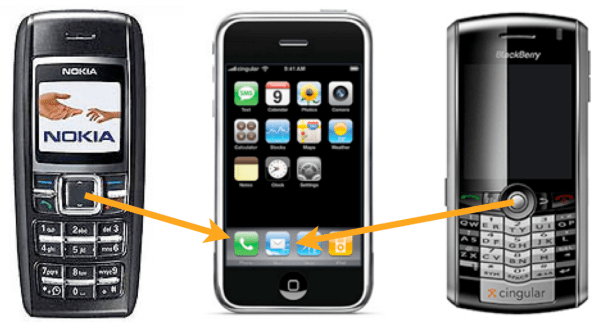
The jobs done by Nokia and BlackBerry were reduced to apps on the iPhone (source)
The problem for Nokia and BlackBerry was that their specialties – calling, messaging, and email – were simply apps: one function on a general-purpose computer. A dedicated device that only did calls, or messages, or email, was simply obsolete.
An even cursory examination of tech history makes it clear that “obsoletion” – where a cheaper, single-purpose product is replaced by a more expensive, general purpose product – is just as common as “disruption” – even more so, in fact. Just a few examples (think about it – you’ll come up with a bunch more):
The typewriter and word processor were obsoleted by the PC
Typesetting was obsoleted by the Mac and desktop publishing
The newspaper was obsoleted by the Internet
The CD player was obsoleted by the iPod
The iPod was obsoleted by the iPhone
[...] The Mac (and PC), iPod, and iPhone weren’t so much disruptive as they were obsoletive. They absorbed a wide range of specialized tools for a price far greater than any one of those tools cost on their own.
[...] the most revolutionary products – all of them, ever more personal versions of truly personal computers – are obsoletive. They are more expensive, more capable, and change the way we live.
Similarly, Excel would be obsoleted by AI. Reduced into yet another Claude Code use case. Or perhaps it would be Claude Cowork, or OpenAI’s Codex, or some other tool. It’s too early to predict the winner, just like it was hard to predict the prospects of Lotus 1-2-3 or Quattro Pro at the height of the spreadsheet wars. My point is, one of those would emerge as the winner, rendering Excel irrelevant along the way.
Sure, there are many issues to work through before we get there, around security, permissions, data accuracy, migration of legacy files (especially in cases where Excel was abused as a database). But remember that the first iPhone wasn’t all that great as a phone or an email machine. It took a few iterations to get it right, complete the obseletion of Nokia and BlackBerry, and get enterprises to adopt it.
While .xlsx files may still be considered the gold standard (particularly in the financial industry) for some time longer, I suspect that this would be a generational thing. Obsoletion seems inevitable. Children who are “growing up with the thing” will be more proficient and comfortable with AI than anyone my age would probably ever be; could you imagine them “programming” Excel Spreadsheets in a decade or two from now?
To paraphrase Steve Jobs, there is something very special, and very historically different, that takes place when you have one person and one AI software developer.
For new posts to land directly in your inbox:
Not financial advice. This post is for educational and general purposes only and should not be relied upon for investment decisions
Jobs was probably still involved with the Lisa project at that point, but was forced to leave shortly thereafter and eventually took over the Macintosh team in 1981.
Microsoft was a close partner and a key software vendor for the Macintosh, which originally launched with Multiplan, a Microsoft spreadsheet program that was adapted from MS-DOS. With the introduction of a more performant Macintosh version in 1985, Microsoft launched a Excel in September 1985, which was natively built for the Mac GUI.
Well-written, this understanding that we see AI moving so fast and replacing things that we thought they have a real moat. It's the discussion we had on the buy side (and we are seeing the rotation in live). With that, I will say not all the software companies are the same. There is a benefit from our analysis to the niche that caters to very specific market, use case, and that they are being protected by regulatory constraints.


Well-written, this understanding that we see AI moving so fast and replacing things that we thought they have a real moat. It's the discussion we had on the buy side (and we are seeing the rotation in live). With that, I will say not all the software companies are the same. There is a benefit from our analysis to the niche that caters to very specific market, use case, and that they are being protected by regulatory constraints.