
Google and the Open Web
Some thoughts on the recent anti-trust ruling, Google's past relationship with the open web, and potential future

From Reuters:
U.S. District Judge Leonie Brinkema in Alexandria, Virginia, found Google liable for "willfully acquiring and maintaining monopoly power" in markets for publisher ad servers and the market for ad exchanges which sit between buyers and sellers. [...]

U.S. Attorney General Pamela Bondi called the ruling "a landmark victory in the ongoing fight to stop Google from monopolizing the digital public square."

"This Department of Justice will continue taking bold legal action to protect the American people from encroachments on free speech and free markets by tech companies," she said.
It could be funny if Google, as a remedy, offers to simply shut down its publisher ad server and ad exchange. I would be curious to see how the DOJ would respond to this hypothetical offer. Because the outcome might not be all that great for “free speech” on the “digital public square”. Let me take a few steps back and explain -
Google Ads and the Open Web
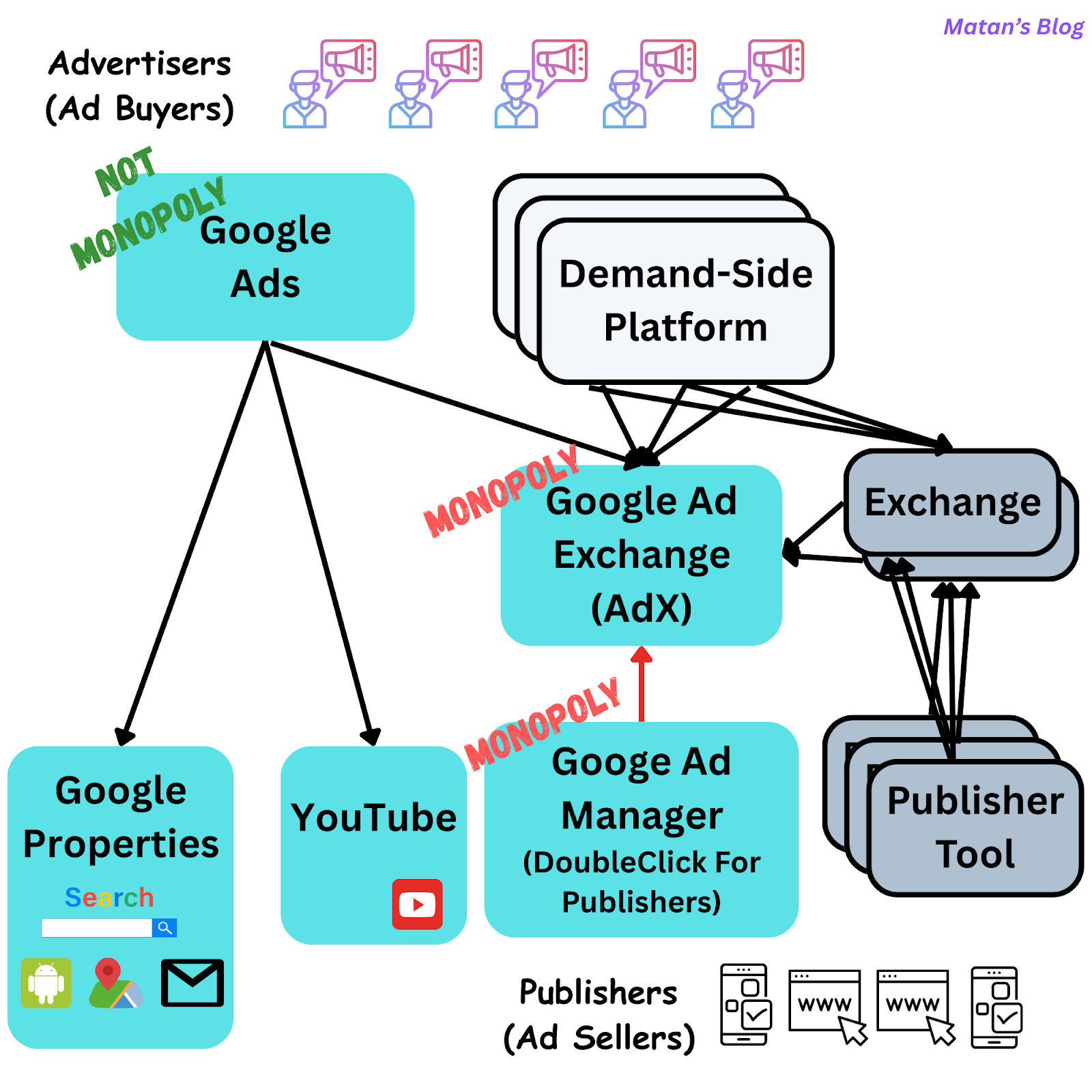
The diagram is simplistic – there are so many moving parts in this stack that haven’t been included – but it illustrates the general structure of the market: at the top there are buyers – advertisers looking to buy ads; the sellers at the bottom are referred to as publishers – websites and mobile apps looking to sell ad display space. A whole ecosystem of products and tools has evolved to connect buyers and sellers in this giant real-time auction market.
I’m not a legal expert, and I don’t want to dive into the way markets were defined by the DOJ in this case (always a controversy in antitrust cases). This section simply tries to explain the lay of the land.
At the center, Google’s Ad Exchange (AdX) operates auctions on ad placements, takes a cut from every transaction, and – as per a ruling by Judge Leonie Brinkema from April 17 (which Google intends to appeal) – holds a monopoly in the “open-web display ad exchange market”.
In a great Stratechery post after the DOJ complaint was filed (Jan 2023), Ben Thompson, using quotes from the claim itself, showed how Google’s ad business is a textbook example of an aggregator.
Bids to the exchange may be placed by any “authorized buyer” – for example The Trade Desk or Amazon’s ad broker – but the majority of demand comes from Google Ads1. As the only way to buy ads on Google properties, Google Ads draws a lot of the advertisers – it’s just more convenient to manage their advertising budget in one place, alongside the bids for “open-web” advertising. In other words, despite there being many other platforms to acquire display ads on the web, Google was able to aggregate the demand for open-web advertising.
While there are many competing demand-side platforms, routing bids to many open-web exchanges – all of which may also route their bids to Google’s AdX – Google Ads only places open-web bids on Google’s Ad exchange.
On the supply side, many tools are available for publishers to offer their ad space for sale, but only through the Google Ad Manager (or “DoubleClick For Publishers”, DFP) they could list inventory on the Google Ad Exchange2. This makes DFP the only path for publishers to access the vast demand coming from Google Ads, which Judge Brinkema found as an unlawful tie, violating the Sherman Act.
Google Ads and Google Search
This is something Larry Page said in a TED talk he gave with Sergey Brin in 2004, about what excites him about the future:
… we have this thing called AdSense [...] these ads are generated automatically -- like in this case, on the Washington Post -- from the content on the site. And so we use our over 150,000 advertisers and millions of advertisements, so we pick the one that's most relevant to what you're actually looking at, much as we do on search. So the idea is we can make advertising useful, not just annoying, right?
And the nice thing about this, we have a self-serve program, and many thousands of websites have signed up, and this lets them really make money. [...]
I met this guy who runs a conservation site at a party, and he said, "You know, I wasn't making any money. I just put this thing on my site and I'm making 10,000 dollars a month. And, you know, thank you. I don't have to do my other job now."
I think this is really important for us, because it makes the Internet work better. It makes content get better, it makes searching work better, when people can really make their livelihood from producing great content.
AdSense was the initial product that eventually led to Google’s open-web advertising business3. I can get why Page was excited by this! It was highly visionary of him to imagine (and create) a fully-automated self-service advertising network that covers the entire world wide web.
I think that for Page, this tied into the 2002 talk I mentioned, where he described Nikola Tesla as a role model:
At a pretty young age I wanted to be an inventor. Actually I read an autobiography of Tesla … the guy who invented AC power and generators and all sorts of things that we use today.
He barely was able to support his work - he's probably one of the greatest inventors of all time, and he's sort of pathetic in that, you know, he would have been able to do more if he was better at commercializing his inventions.
With its ads business, Google could avoid Tesla’s “sort of pathetic” side. The ever-growing stream of profits could be used to fund further and greater inventions. and – since website owners (publishers) were also able to make money – it kept the web open and free. The only price is that users have to see ads, but at least they’re useful and “not just annoying”.
I think that this is the mental model Google had about its ad business, and what justified internally some of the questionable and not-very-exciting acts described in the complaint; I worked for Google in the past (full disclosure!), but was never part of the Ads organization and never heard anyone talking about ads in these terms. I actually never learned much about ads as a Google employee – this is something I studied by myself, from publicly available sources, after I had left Google and continued to hold Google shares (another disclosure!). With these disclaimers out of the way – I think that’s the right way to understand the Google mentality around search and ads.
Here is how Page ended his 2004 TED talk:
A couple things really make me excited to be involved with Google, one of those is that we're able to make money largely through advertising, and one of the benefits that I didn't expect from that was that we're able to serve everyone in the world without worrying about, you know, places that don't have as much money [...] everyone in the world has access to our search, and I think that's a tremendous, tremendous benefit.
The other thing I wanted to mention just briefly is that we have a tremendous ability and responsibility to provide people the right information, and we view ourselves like a newspaper or a magazine -- that we should provide very objective information. And so in our search results, we never accept payment for our search results. We accept payment for advertising, and we mark it as such. And that's unlike many of our competitors.
I think decisions we're able to make like that have a tremendous impact on the world, and it makes me really proud to be involved with Google.
So here is one way to look at this: Search is a work of art. A sacred masterpiece. An incredible gift that benefits humanity in a major major way. On par with (or perhaps greater than) Nikola Tesla’s inventions. But. It also costs a lot of money, and this is where Ads come in. Ads allow Google to offer Search, and an incredible family of other products, for free, for everyone in the world; and it also supports open content across the internet – like the guy Page met at that party, who was making $10k/month from AdSense. Yet, unlike Search, Ads isn’t sacred; it’s business. And sometimes in business, compromises have to be made, in order to keep funding all the Search goodness. Which could result in some actions that are not as exciting to talk about. It’s like, Michelangelo would have never compromised the Sistine Chapel over greed, but, you know – perhaps the Medici family had to flex some muscles here and there to maintain their wealth and power, and continue funding Michelangelo.
Now, I have never heard anyone at Google expressing things in this way. I’m also not saying that I necessarily support this view. It is just my own interpretation. If I had to guess, I think that the perspective Larry Page described in the 2004 TED talk, resulted in the way incentives were set at Google – Search being religiously measured on quality and utility, whereas Ads had to focus on growing profits.
Decline of the Open Web
It might be that publishers need Google Ads at this point, more than Google Ads need the publishers; a WSJ article back in 2019 (which has a great visualization of the ad auction flow!), started with this story:
Nexstar Media Group Inc., the largest local news company in the U.S., recently tested what would happen if it stopped using Google’s technology to place ads on its websites.

Over several days, the company’s video ad sales plummeted. “That’s a huge revenue hit,” said Tony Katsur, senior vice president at Nexstar. After its brief test, Nexstar switched back to Google.

[...] When Nexstar didn’t use Google’s selling tool, it missed out on a huge amount of demand that comes through its buying tools, Mr. Katsur said: “They want you locked in.”
That’s interesting. Unlike with industrial era monopolies such as the AT&T phone lines or IBM’s punch cards, there are alternatives. And switching isn’t hard – Nexstar was able to go back and forth for a few days. It’s just that with Google, publishers make so much more money. The lock-in is simply a superior monetization opportunity.
Google, on the other hand, isn’t heavily dependent on the money it’s making from open-web advertising: revenue from Google Network Members' properties declined by 14.5% since peaking in Q4 of 2021; ad revenue for Google-owned properties, meanwhile, grew 21.3% for YouTube, and 24.8% for “Search and other” during the three years since Google Network peaked. Network’s share therefore declined to 11% of Google’s advertising revenue, and 8.25% of Google’s total revenue.
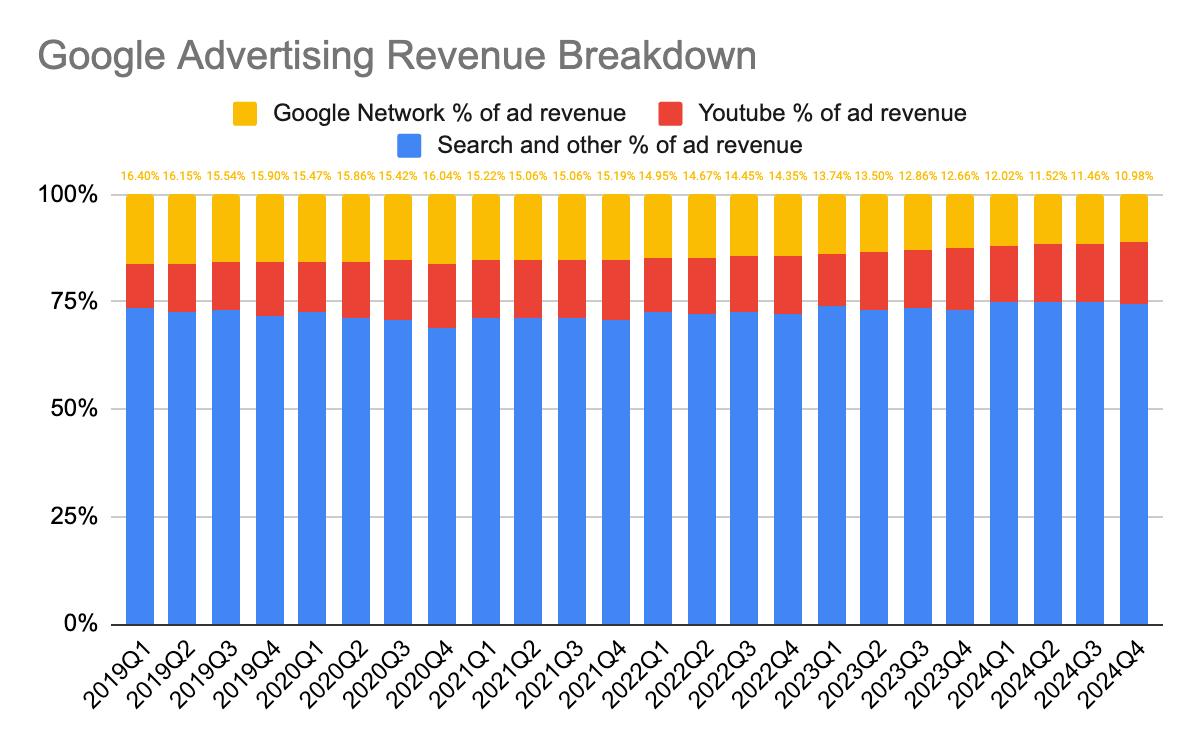
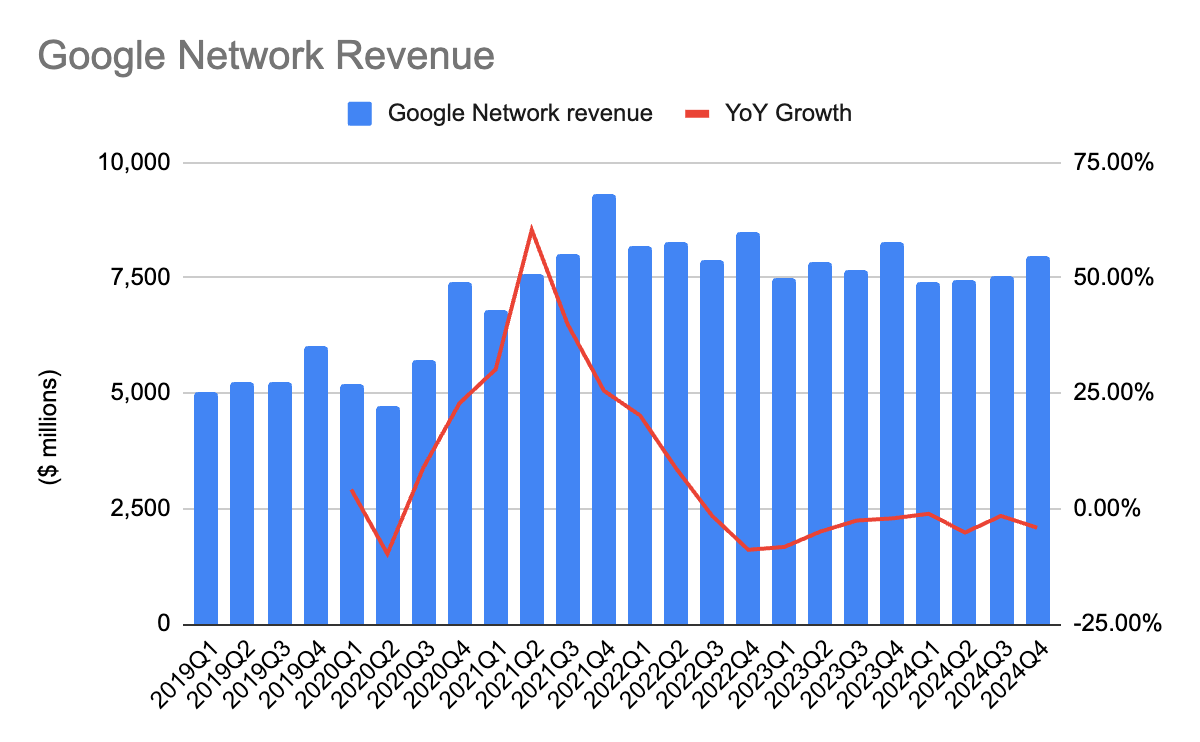
The backstory is probably the secular decline of the open-web, accelerated by the rise of generative AI. Benedict Evans has been writing about “AI and the Death of Links”:
As soon as ChatGPT took off, publishers started muttering about the social contract. Google indexes your content and makes money from that, and it sends you traffic and you can make money from the traffic, or try to. But if an LLM scans your content and everyone else’s, and then just gives people the answer, then you don’t get any traffic.
[...] For any content creator, that contract was that people can discover your content on a platform, and the platform makes money, but to engage with it, people come to you (links), or the platform pays you (YouTube, TikTok), or both. This exchange has often been fraught, with people endlessly complaining about how the search algorithm works or the payout ratio, but there is still always an exchange. If, now, my content is just the raw material for you to synthesise something else, that doesn’t connect to me or pay me at all, then why am I participating?
Alex Kantrowitz recently wrote about the case of Jan van der Crabben, CEO of World History Encyclopedia: the world’s second most visited history website, saw a 25% drop in traffic after AI chatbots started synthesizing its data in their answers. Van der Crabben has since switched to a subscription model, which is maybe great news for the 2,000 or so readers who love the website so much that they’re willing to pay for it – since World History Encyclopedia will keep running; the remaining millions of occasional visitors, however, would now have to rely on LLMs. And if previously-open websites are forced to put up paywalls, how would LLMs get new content?
These are fascinating questions that probably warrant their own article; the point I’m trying to make here, for now, is that the entire “open-web” market – the subject of the antitrust trial – is in decline, and is of lesser and lesser importance for Google.
The Open Web And AI Future
Back to my opening proposition: what if Google offers to shut down its ad exchange and publisher tool? I am mostly joking, as there are many good reasons for Google fighting to keep its publisher ad product, let alone not voluntarily killing it. Still, it’s an interesting thought experiment: how would the DOJ respond? the implication for Google, if it were to shut down its ad publisher, might sum to losing a shrinking portion of its business, currently contributing 8% of its revenue; for open-web publishers, though, this might be a death sentence. At least in the short run.
As for the long run, well - AI is coming! The long tail of the open web – the prized winner of the internet revolution, which had flourished thanks to traffic and monetization opportunities provided by Google – is already seeing the pain of the next paradigm shift. It’s unclear what opportunities Generative AI could offer publishers, and for now the main course of action seems to be trying to resist it.
In hindsight, Microsoft could have benefitted from a forced breakup of its Windows and Office businesses back in 2000 – which the court had initially ordered, until the DOJ reversed the decision – since it would have prevented Microsoft’s mistake of orienting the entire company around Windows, while Windows was losing ground to mobile operating systems. The same logic might apply for Google Ads, while open web advertising would be losing ground in favor of, well, however ad campaigns are going to be run in the Generative AI era.
It could be that divesting its ad exchange and publisher system, at this point in time, would turn out to be extremely favorable for Google. Instead of having to worry about milking whatever billions of dollars still left to extract in open-web display advertising, Google would be forced to focus on creating a new ecosystem. One that offers content creators the opportunity to embrace generative AI and thrive with it, just like Google had originally done in the early days of the web. Now that could be something to be proud of.
There are additional Google tools for demand side, such as Display & Video 360, which I did not specifically mentioned.
For simplification, I’ve discarded AdMob, built for ads on mobile, and AdSense, a network for ads on websites. The unified Google Ad Manager presumably aims to support inventory across all platforms.
There’s a fun story about how AdSense was created based on a rogue prototype that a Google engineer hacked together overnight, and how it led to the creation of Google’s 20% policy. I’ll leave it for another time.
Disclosures: I am long GOOG and may sell at any time, all opinions and views are my own, no investment nor legal advice.