

Many takes circulated on reports that Microsoft is winding down internal use of Claude Code, reading it as if productivity gains couldn’t justify the costs of AI coding. But that’s not what actually happened. There is no question that coding agents generate value; the open question is about who gets to capture said value. Some historical context first -
Telecom Infrastructure and Value Capture
A recent Benedict Evans essay carried a chilling warning for the frontier AI labs:
In the last 20 years, mobile network traffic has risen by several thousand times, and yet the stocks have been flat. The industry has revenue of over a trillion dollars a year, and capex of $200bn or so, and the technology is amazing, but this is low-margin commodity infrastructure. These companies imagined everything we do with smartphones today, but when it happened it was built by other companies, further up the stack, and they didn’t get any of the value from it.
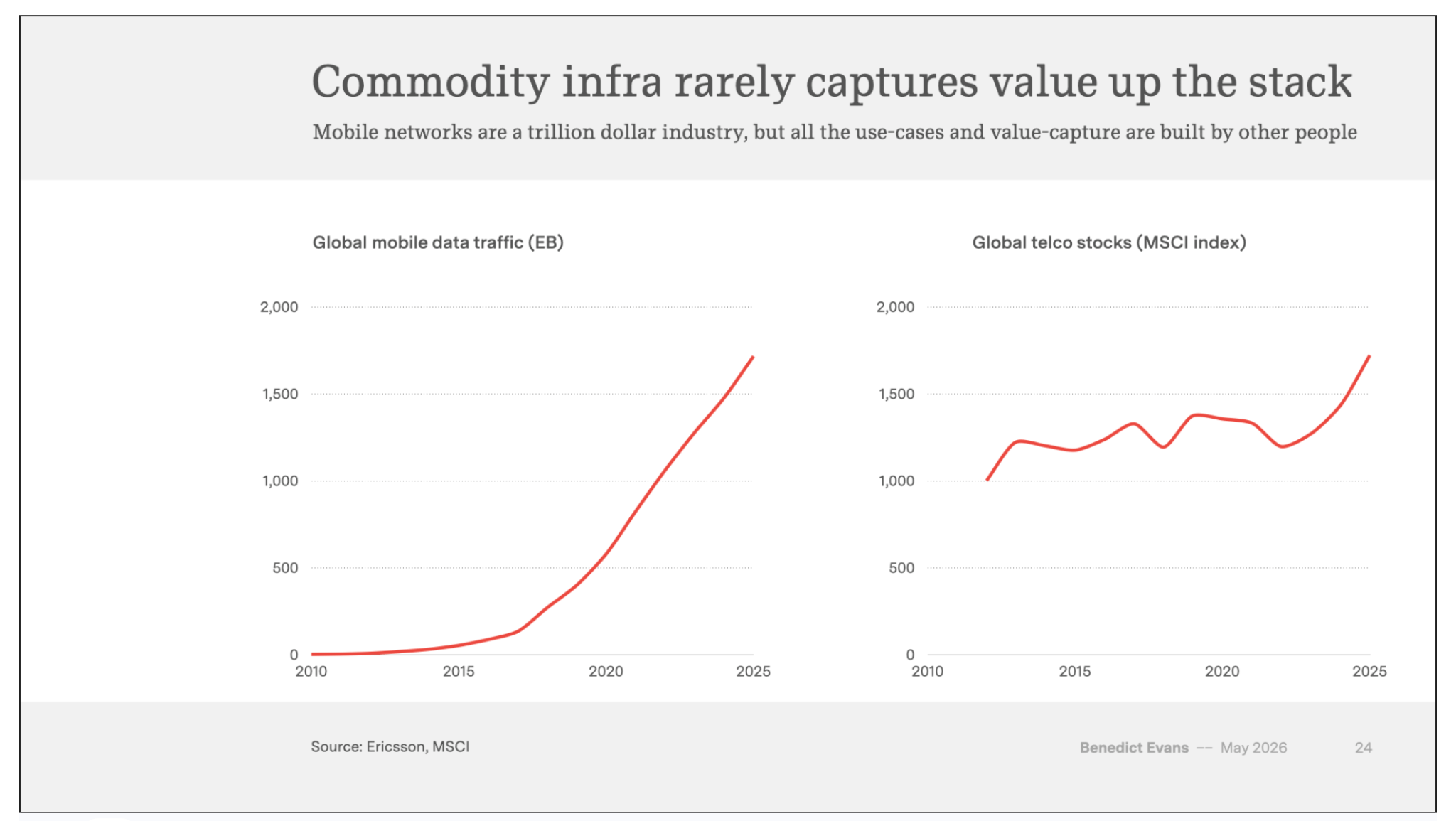
We’ve talked about the 1990s “You Will” campaign by AT&T: executives at the telephone company have, over three decades ago, thought about most of the things we do with our phones today – from watching movies on demand to joining meetings from the beach and video-calling your family while on the road. And yet, despite commanding a customer base of over 100M wireless subscribers, the stock1 underperformed the index. Not to mention its massive underperformance compared to the one company that ended up capturing the vast majority of the value that was enabled by the major investments undertaken by AT&T (and the other major telecom companies): Apple ended up keeping the lion’s share of profits generated by the mobile revolution.
How did that happen? Exactly as researcher David Isenberg of AT&T Labs had predicted in his 1997 The Rise of the Stupid Network: “the internet dis-intermidiated the telephone network,” he explained, reducing what once was an intelligent network to a stupid network.
That wasn’t obvious, however, in the early days of mobile; yes, device makers – led by Nokia – made money (largely thanks to the European GSM standard), but US carriers maintained control over the stack thanks to incompatible standards2 and locked phones. The devices were subsidized by the mobile carriers and sold in their stores. They controlled the app layer, which, for example, allowed the telcos to make $1.3B from selling ringtones in 2007.
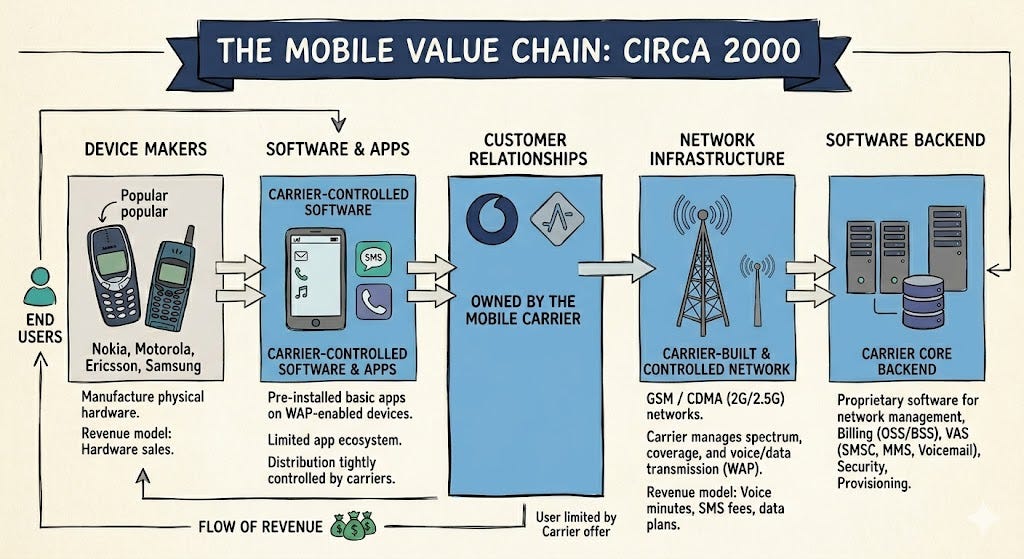
So it seemed like a wise bet for the telecom carriers to bid billions of dollars for spectrum and spend many more billions building out the 3G and 4G networks infrastructure. The chokehold over the value chain was their moat. And businesses with strong moats have pricing power over their customers and leverage over their vendors, which means they can generate high returns on investments.
Alas, the bet failed. The iPhone, followed by Android, created a new integration on the end-user’s side, while the hyperscalers created another integration on the backend side. The mobile networks themselves were reduced to – as one telco CEO described it last year – “being a pipe of packets just getting data across the networks.” The 1997 Stupid Network warning materialized, which explains why the investments made by telecom carriers – building what turned out to be fungible commodities – hardly generated returns.
Which raises the obvious question: hyperscalers built huge capital-intensive and undifferentiated infrastructure; how did they avoid the low-returns fate of the telecom companies?
The Cloud and Conservation of Attractive Profits
It’s a shame Prof. Christensen chose an academic and dull name such as “The Law of Conservation of Attractive Profits” to describe what is a fascinating insight; It would probably have been more widely known had it been given a catchy name like “Disruption”. From The Innovator’s Solution:
[...] Whenever it [commoditization] is at work somewhere in a value chain, a reciprocal process of de-commoditization is at work somewhere else in the value chain. And whereas commoditization destroys a company’s ability to capture profits by undermining differentiability, de-commoditization affords opportunities to create and capture potentially enormous wealth.
[...] The ability to differentiate shifts continuously in a value chain as new waves of disruption wash over an industry. As this happens, companies that position themselves at a spot in the value chain where performance is not yet good enough will capture the profit. That is the circumstance where differentiable products, scale-based cost advantages, and high entry barriers can be created.
Christensen wrote this years before the iPhone and AWS launched, yet it perfectly describes what Mobile and the Cloud did to the telecom carriers: the network layer got commoditized, and the point of differentiation moved to the endpoints: the smartphones and the backend servers powering them. The iPhone created its own value chain chokepoint, bundling direct relationships with users with both the device hardware and the client-side of software applications.
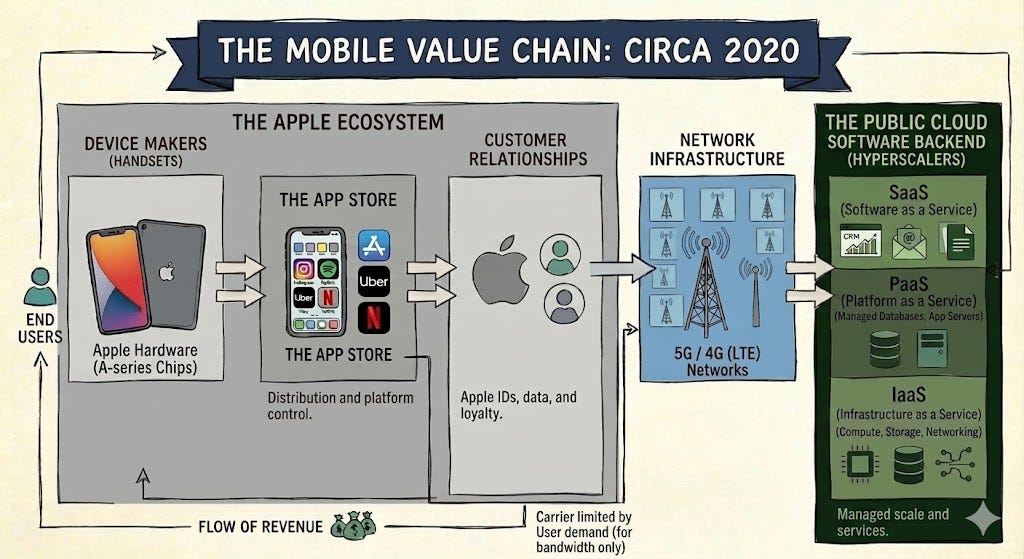
What about the backend? Analysts were skeptical as Amazon, followed by Microsoft and Google, were pouring money into building their cloud infrastructures. The consensus viewed cloud computing as a utility – huge investments, no differentiation, and low margins. As was the case for mobile telecom carriers.
A race to the bottom over compute and storage prices seemed to confirm this view: Amazon’s 65% storage price cut of March 2014 was AWS’s 42nd price reduction since 2008. Microsoft and Google followed with similar cuts. There were, of course, cost reductions gained through economies of scale, but it seemed like they were all flowing to the cloud customers3.
Amazon blew everyone’s mind when they broke out AWS financials in 2015 – which Ben Thompson referred to as the “AWS IPO”:
This is why Amazon’s latest earnings were such a big deal: for the first time the company broke out AWS into its own line item, revealing not just its revenue (which could be teased out previously) but also its profitability. And, to many people’s surprise, and despite all the price cuts, AWS is very profitable: $265 million in profit on $1.57 billion in sales last quarter alone, for an impressive (for Amazon!) 17% net margin.
The jaw-dropping profitability kept on improving – from AWS: Pre and Post-ChatGPT by MBI Deep Dives:
By 2021, AWS operating margin became ~30% and ROIC improved to mid-20s. The incremental ROIC looked even more attractive as AWS routinely posted mid-30s ROIIC in the pre-ChatGPT world.
How could the hyperscalers generate such lucrative returns out of building fungible infrastructures?
Well, it turns out that subsidizing the Infrastructure-as-a-Service (IaaS) layer – renting out compute, storage, and networking at breakeven (or even at a small loss) – allowed the hyperscalers to lock-in customers, and make money through selling Platform-as-a-Service (PaaS): managed databases, application servers, analytics pipelines. Yes, at a high level, the pieces making up the IT stack remained the same as they did in the on-premise era, which led to the famous 2009 lash out by Oracle founder and then-CEO Larry Ellison:
The absurdity ... oh, it’s in the cloud ... it’s databases! and operating systems! and memory! and microprocessors! and the internet! And all of a sudden it’s none of that, it’s the cloud! What are you talking about?!?
Ellison was, of course, correct that “cloud” was still made of databases and operating systems and memory and microprocessors and networking; what he missed, however, was that these layers – some of which used to produce attractive profits – got commoditized.
The hyperscalers offered proprietary databases, operating systems, networking, microprocessors – “Primitives”, in Amazon’s terminology – which were good-enough for most. What was not yet good enough, to borrow Christensen’s terms, was the ability to run your software on a globally available, highly reliable, scalable and secure backend infrastructure, capable of serving the billions of iPhone and Android carrying users. This was only possible through huge data center investments, which Oracle and IBM failed to make. That was the spot – to use Christensen’s terms – where the attractive share of profit was captured.
An on-prem Oracle Database install used to be a beachhead for selling Oracle applications, BI, and middleware. The cloud neutralized it. Developers were willing to accept whatever database option was available on the cloud admin console. That’s how Oracle Database – once the gold standard of software systems – lost its lucrative status, and how many alternatives – from Amazon’s own Redshift to a plethora of NoSQL databases – emerged4.
By locking in enterprises and commoditizing the IT stack, cloud hyperscalers were able to earn fantastic returns on their investments for over a decade. The emergence of containers such as Kubernetes threatened to loosen the hyperscalers’ grip, but to no avail. Every new API or service a developer added via the cloud console became another tie-in point. The lock-in accumulated, one integration at a time, to the extent that migration became a highly risky and complex proposition. It turned out that migrating workloads across clouds wasn’t as simple as switching to a different mobile network and sticking a new sim card into your phone.
Which leads to questions about, what else, AI.
Coding Harness and the Agentic Value Chain
AI, of course, triggers new shakeups across the value chain, thus creating new opportunities for value capture. Ben Thompson wrote on Stratechery last week:
In the short run, as long as there are shortages, there is money to be made at every level of the stack; in the long run, once supply and demand come into balance, the most value accrues to whoever [...] is able to integrate around a bottleneck in the stack and commoditize everyone else.
While that article analyzed the tensions between Nvidia and the hyperscalers, the latter have another frenemy elsewhere in the stack: the model makers.
The majority of AI revenue, at any given moment, flows to the frontier LLM (according to a model by SemiAnalysis), which means the AI labs must constantly spend money on training the next frontier model, while the previous ones depreciate quickly. The returns are yet to be known, and – despite the unprecedented scale of Anthropic’s recent revenue growth – there is still a reason for concern. Mobile carriers were also growing rapidly in the early 2000s. At some point the S-Curve flattens, and it’s unclear where profits will flow. To capture the attractive share – rather than settle for the utility-like returns generated by the mobile buildout – Anthropic must create a chokepoint over the stack and commoditize the cloud providers.
One way to do this is through subsidies. It doesn’t always work: the device subsidies offered by mobile carriers failed to lock customers into their data plans, but the hyperscalers were successful in executing a ‘subsidize IaaS to upsell PaaS’ strategy.
Anthropic has been subsidizing tokens for customers who use its own harness: Claude Code. While Claude models are available through a variety of AI coding tools – such as Google’s Antigravity, Microsoft’s GitHub, or potentially-soon-to-be-xAI’s Cursor – it is heavily subsidized when consumed through a Claude Code subscription. Simon Willison recently reported that he consumed $1,199.79 worth of tokens through his $100/month Max plan from Anthropic (over a 90% discount!)
And it’s not just about subsidies: a code leak in March revealed Claude Code as much more than a thin model wrapper. Gabriel Anhaia’s breakdown on Medium reported a system of ~40 built-in tools and a 46,000-line query engine. VentureBeat called it “a complex, multi-threaded operating system for software engineering.” Since, said “software engineering OS” was enhanced with managed agents hosting, dynamic workflows, and a compliance API that integrates with all popular security and compliance platforms.
Anthropic is building Claude Code into what could be the new orchestration and control plane, displacing the cloud admin consoles. It can be seen as an attempt to do what Kubernetes failed to achieve: commoditize the hyperscalers, as Claude Code can routinely provision and migrate workloads across clouds (even in cases that require rewriting an integration with a proprietary cloud API). If successful, the hyperscalers would be reduced to “stupid” IT rental service.
With that framing, here is the recent report from The Verge:
Microsoft first started opening up access to Claude Code in December, inviting thousands of its own developers to use Anthropic’s AI coding tool daily. It was part of an effort to get project managers, designers, and other employees to experiment with coding for the first time, and sources tell me that Claude Code has proved very popular inside Microsoft over the past six months. Perhaps a little too popular, as Microsoft is now preparing to walk back its Claude Code push.
I understand that Microsoft is planning to remove most of its Claude Code licenses and push many of its developers to use Copilot CLI instead. While Claude Code has been a popular addition, it has also undermined Microsoft’s new GitHub Copilot CLI coding tool — a command line version of GitHub Copilot that runs outside of development apps like Visual Studio Code.
I’m told that Microsoft’s Experiences + Devices team, which includes the engineers responsible for Windows, Microsoft 365, Outlook, Microsoft Teams, and Surface, is winding down its usage of Claude Code by the end of June. Sources tell me that engineers are being encouraged to start transitioning their workflows to GitHub Copilot CLI in the coming weeks, ahead of the cutoff.
Microsoft didn’t conclude that AI coding is not working; to the contrary: it’s working too well. To the extent that it poses a threat to Microsoft Azure down the road.
Microsoft employees are still going to use AI for coding. They’re likely even still going to use Claude models. They’re just not going to do so via the Claude Code harness. Probably because Microsoft doesn’t want to lock itself into Anthropic’s “operating system for software engineering.” More broadly, Microsoft doesn’t want any company locked into Anthropic, and the first step is starting at home.
The hyperscalers’ counter strategy is attempting to commoditize the model layer itself. Just as they successfully did with databases, application servers, and other IT building blocks in the past. Microsoft is pushing its employees into its own coding harness, GitHub Copilot, hoping that will gain traction. Similar to Google’s Antigravity – which announced its improved 2.0 version at Google I/O last month5 – the model is treated as a fungible commodity. The dropdown menu lists Claude Opus alongside a variety of other models.


GitHub Copilot also has an auto mode, where it “automatically selects the best model for each task.” This could help optimize the soaring costs of tokens. But, also, abstracting away the coding model is an attempt at commoditizing the models layer, mirroring Claude Code’s strategy of trying to abstract away the cloud environment where agents are running.
These are, to clarify, only initial attempts. It’s unclear whether GitHub Copilot will gain much adoption. Same for Claude Code’s advanced offerings. The frontier labs and hyperscalers will keep trying to commoditize each other for a while. We are still at the early phase in the cycle where the tide lifts all boats, and it remains to be seen who is able to capture the attractive share of profits. Just like it wasn’t obvious, back in 2010, that it was going to be Apple and Amazon, and that it wasn’t going to be Verizon or IBM.
What is clear at this point, however, is that – contrary to how the Microsoft news was interpreted – Anthropic found product-market fit so strong that it might threaten the major hyperscalers. Agentic AI is definitely a big deal.
Disclaimer: Long GOOG. Not financial advice. This post is for educational and general purposes only and should not be relied upon for investment decisions.
I did omit the fact that it wasn’t the same AT&T! the 1993 ads were ran by the original Ma Bell company, whereas the “AT&T” that is publicly traded today is the result of South Bell Corporation — one of the “baby bells” spun out of AT&T in 1984 — buying the mother company in 2005. A (very interesting!) story for another day.
Namely, CDMA/TDMA, which were incompatible and prevented US customers from easily switching between mobile carriers.
Avid readers may notice the parallels to Berkshire’s failing textile operations.
Oracle finally accepted this reality only a few years ago, when it started to (successfully) offer its database as a managed PaaS service on the major clouds.
This is probably also why the Google I/O keynote showed so many different agentic tools by Google; many mocked the fact that Google is launching overlapping half-baked products, but that’s just how Google rolls. The interesting signal to me was that so many teams at Google are rushing to incorporate AI agents.
Very nice post.
Anorher big missing example is Java - as a way to comodetize the OS layer.