
Warren Buffett's Close Shave With The Internet
The surprising story about how "the internet isn't going to affect how people shave" prediction turned out incorrect

“We’re Looking For The Very Predictable”
“I don’t think the internet is going to affect how people chew gum”
- Warren Buffett, 1998
While he may have gotten this one right, he was surprisingly wrong about another industry. There is Buffett, talking about the internet, and why he keeps his investments away from it, in 1998 – as the dot-com mania was growing – sitting on stage next to his friend and then-CEO of Microsoft, Bill Gates:
I didn’t get it[, the internet,] at first but it’s huge, and it will change the world, the technological revolution, in dramatic ways. Ironically our approach to that is just the opposite of Bill’s. His is the right one for the world, ours is the right one for me.
I look for businesses where I think I can see what they’re gonna look like in 10 or 15 or 20 years. We don’t own any, but if you take Wrigley’s chewing gum – I don’t think the internet is going to affect how people chew gum. Bill probably does, I mean (laughing).
But I don’t think it’s going to affect the fact that Coke will be the drink of preference and will gain in per capita consumption around the world. I don’t think it’ll change whether people shave, or how they shave, or the fact that they like a better shaving system, as the Mach 3 is going to be very shortly I might add.
So we’re looking for the very predictable, and you won’t find the very predictable in what Bill does. You’ll find the more exciting things, the things are going to change society more. So I have a little different opinion. As a member of society I applaud what he’s doing; as an investor, I keep a wary eye on it.
It’s a different approach to investing. Most people think about all these opportunities, and it has been opportune; internet stocks have gone crazy here in recent months. But I don’t know how to look at one or the other and tell the winners.
What a fascinating and contrarian insight: in the face of high-flying dot-com stocks, concentrating on businesses that are not going to be impacted by the internet. The internet is not going to change how people shave. At the end of 1998, Buffett’s Berkshire Hathaway owned $4.6B worth of Gillette stock, roughly 12.5% of Berkshire’s stock portfolio. Its fifth largest position.
Buffett famously explained that he could sleep well at night owning Gillette, knowing that hair is growing on the faces of billions of men on Earth. The strategy of ignoring internet stocks turned out pretty smart in hindsight, after the bubble had burst. There wasn’t in fact a “new internet economy” that he was just too old to understand, as critics used to claim at the height of the bubble. Through boom and bust, Gillette’s customers kept on shaving.
Moreover, the Mach 3 – which Buffett mentioned above – came out in 1998, leading to an almost 50% growth in blade and razor revenue for Gillette. The underlying demand hardly changed – the facial hair growth that had Buffett sleeping well at night hasn’t become faster or more widespread – but the Mach 3 added a third blade, an excuse for Gillette to increase prices (and quickly recoup the $750M of R&D investment).
There was, however, one assumption that Buffett got wrong; the internet was going to significantly – and adversely – affect Gillette’s business. People didn’t really want to keep paying more for a “better shaving system”, if there was only a cheap alternative that was good enough. The internet would ultimately enable exactly this kind of competition, to the detriment of Gillette. It’s just that another decade was needed for all the infrastructure pieces to be put in place.
“I Would Be Amazed If Gillette Lose Market Share”
This is Warren Buffett talking about Gillette again, during Berkshire Hathaway’s 2002 annual shareholder meeting:
Gillette now has 71 percent, by value, of the blade and razor business in the world. Just think of that. I mean, 71 percent.
Here’s a product that everybody knows what it does, they know where it’s sold, they know that it’s a high-margin business. I mean, it isn’t like the capitalist world is unaware of the money that could be made if they could knock off Gillette.
But they can’t knock off Gillette, and it’s 71 percent. And that’s a little higher percentage than when I wrote about it [...] And I would say that 5 or 10 years from now I would be amazed if Gillette … has lost market share […]
And amazed he should be, as roughly a decade later, this happened:
Euromonitor said Gillette has lost market share for the last six years. The data firm estimates the company’s share at just 54% in 2016, down from 59% in 2015 and as much as 70% in 2010.
Interesting how that happened; clearly it has nothing to do with the internet, does it? Well, I hate to break it to you, but Buffett’s prediction turned out to be false. Gillette started losing market share after this video was uploaded to Youtube:
I’m Mike, founder of DollarShaveClub.com. What is DollarShaveClub.com? Well, for a dollar a month we send high quality razors right to your door. Yeah! A dollar! Are the blades any good? No, our blades are fucking great.
Do watch the whole ad if you haven’t; it’s one of the best launch videos ever. In 90 short seconds, Dollar Shave Club founder Michael Dubin is essentially destroying Gillette’s moat.
It was in fact possible to knock off Gillette; that’s exactly what Dorco, a South Korean manufacturer of shaving razors and blades, was able to get done. Much earlier. Dorco’s razors were good enough, cheap, and yet – they only captured around 1% of the US cartridge market. Compared to Gillette’s expensive product, that still commanded 70% share prior to Dubin’s 2012 video.
To understand how Dollar Shave Club was able to penetrate Gillette’s moat, we must first take a step back and analyze what made up that moat in the first place. Yes, Warren Buffett was sleeping well knowing that hair was growing on billions of men’s faces every night, but why would they necessarily shave it with a Gillette razor?
Gillette’s Moat
The answer was provided by Ben Thompson, who referred to it as “The P&G1 Formula”:
P&G leveraged these resources in a simple formula that led to repeated success:
Spend significant resources on developing new products (more blades!) that can command a price premium
Spend even more resources on advertising the new product (mostly on TV) to create consumer awareness and demand
Spend yet more resources to ensure the new product is front-and-center in retail locations everywhere
In a world of scarcity this approach paid off time and again: P&G grew not only because its markets grew, but also because it continually justified price increases due to its innovations.
That same “P&G formula” maintained Gillette’s powerful moat, and enabled it to keep its 71% market share even as it was charging $5 for blade cartridges that cost less than a buck to produce. Until 2010, when the internet started trimming Gillette’s market share as effectively as a 3-bladed razor.
Ben Thompson continues:
To be sure, that distillation was easy-to-mock; in 2004 The Onion famously wrote an article entitled Fuck Everything, We’re Doing Five Blades:
The market? Listen, we make the market. All we have to do is put her out there with a little jingle. It’s as easy as, ‘Hey, shaving with anything less than five blades is like scraping your beard off with a dull hatchet.’ [...]”Surprisingly, though, when the Onion’s satire became reality — Gillette launched the five blade Fusion with a 40% price premium in 2006, after being acquired [by P&G in 2005] — sales were slower than expected: many customers decided that three blades were good enough. Still, things weren’t that bad for Gillette and P&G: customers just kept buying the Mach 3. No business model worth $57 billion falls apart just because one component hits a soft spot!
During the same year Gillette introduced its over-the-top 5-blade Fusion blade – 2006 – several platforms were launched on the internet. Youtube2 enabled free video publishing online, and Facebook launched the News Feed, which enabled free content distribution (if you are lucky enough to make your video go viral). Two additional products of the 2006 vintage – AWS and Shopify – haven’t been used by Dubin, but they were crucial to enabling the D2C e-commerce wave pioneered by Dollar Shave Club. The Disruption of Everything, Ben Thompson has aptly named it. Interestingly enough, the Dollar Shave Club website itself was initially hosted on a physical server in the founder’s apartment.
The combination of these platforms has compromised Gillette’s moat: the blades themselves were good enough (“fucking great”) and required no additional R&D investment; Dubin’s video went viral – reaching 26 million views – at virtually no cost (unlike expensive TV advertising), and the direct-to-consumer model bypassed traditional retailers. The internet has unlimited shelf space.
Despite the convincing arguments made by Buffett and Gates back in 1998, the internet had ramifications that went far beyond tech companies like Microsoft. It undermined the once-impenetrable moat around Gillette, and shaved 16% of its market within six short years. Amazing, huh?
Razor Blades and Internet Disruption
What was going on inside Gillette during that time? From the book Billion Dollar Brand Club:
… At Gillette’s headquarters in Boston, the reaction [to Dollar Shave Club launch video] was a collective yawn. Okay, Dubin’s video was humorous. But the blades themselves?
“Their blades are not fucking great. It’s just not true,” a former Gillette senior executive recalls thinking at the time. “Our customers love our product, and they’re not going to switch to this piece of junk” [...]
“Gillette knew more about Dorco blades than Michael Dubin did,” says Mike Norton, a former Gillette executive. “Our side-by-side tests would prove to you that you could take any Gillette razor, and it would be better than Dollar Shave Club.” That includes the Gillette Mach 3, he claims, referring to a model introduced way back in 1998.
Does this type of response sound familiar? This is exactly how an incumbent reacts. That is The Innovator’s Dilemma. Akin to Steve Ballmer’s “haha $500 and it doesn’t even have a keyboard” comment when the iPhone was announced. Or Larry Ellison’s mockery of “the absurdity” and “nonsense” of the cloud. Or Check Point’s initial reaction to Palo Alto Networks. Even Buffett himself, when asked about GEICO in the context of how Progressive adopted telematics.
Gillette’s executives were right that their blades were far superior in quality, but they were inferior in other aspects: they were expensive, and a hassle to buy. One would have to physically get to a store (and often ask for them, since the small and easy-to-steal boxes were often kept in locked cases or behind the counter). Millennial men in particular found Dollar Shave Club’s lower prices and higher convenience as an attractive offering. Plus it offered a “sticking it to the man” appeal. This group was willing to compromise on the actual quality of the blades.
Gillette continues to behave like a textbook incumbent, paralyzed in the face of a disruptive new business model; Billion Dollar Brand Club continues:
Even as Gillette’s market share kept declining, its response was tepid. It tried to counter with its own Facebook video ad, which was mocked wildly as a lame response to Dollar Shave Club’s.
In 2014 it introduced the me-too “Our Shave Club,” but to avoid angering stores that sold Gillette blades, it required customers to initially subscribe through a “preferred retailer” rather than directly from Gillette.
“We never wanted to have to be called into Walmart and told, ‘Wait a minute, you’re selling razors direct to consumer? You sell through us, or we’re going to take your razors out of here.’ The risk-reward wasn’t big enough,” explains Mike Norton, the former Gillette executive.
Frustrated, Gillette filed a patent infringement lawsuit against Dollar Shave Club in 2015, as well as launched a series of ad campaigns; none of that, however, had prevented Dollar Shave Club from reaching an annual sales rate of $240M in 2016, by attacking Gillette’s “shave tech you don’t need”. One popular Dollar Shave Club ad simply showed the prices side-by-side.
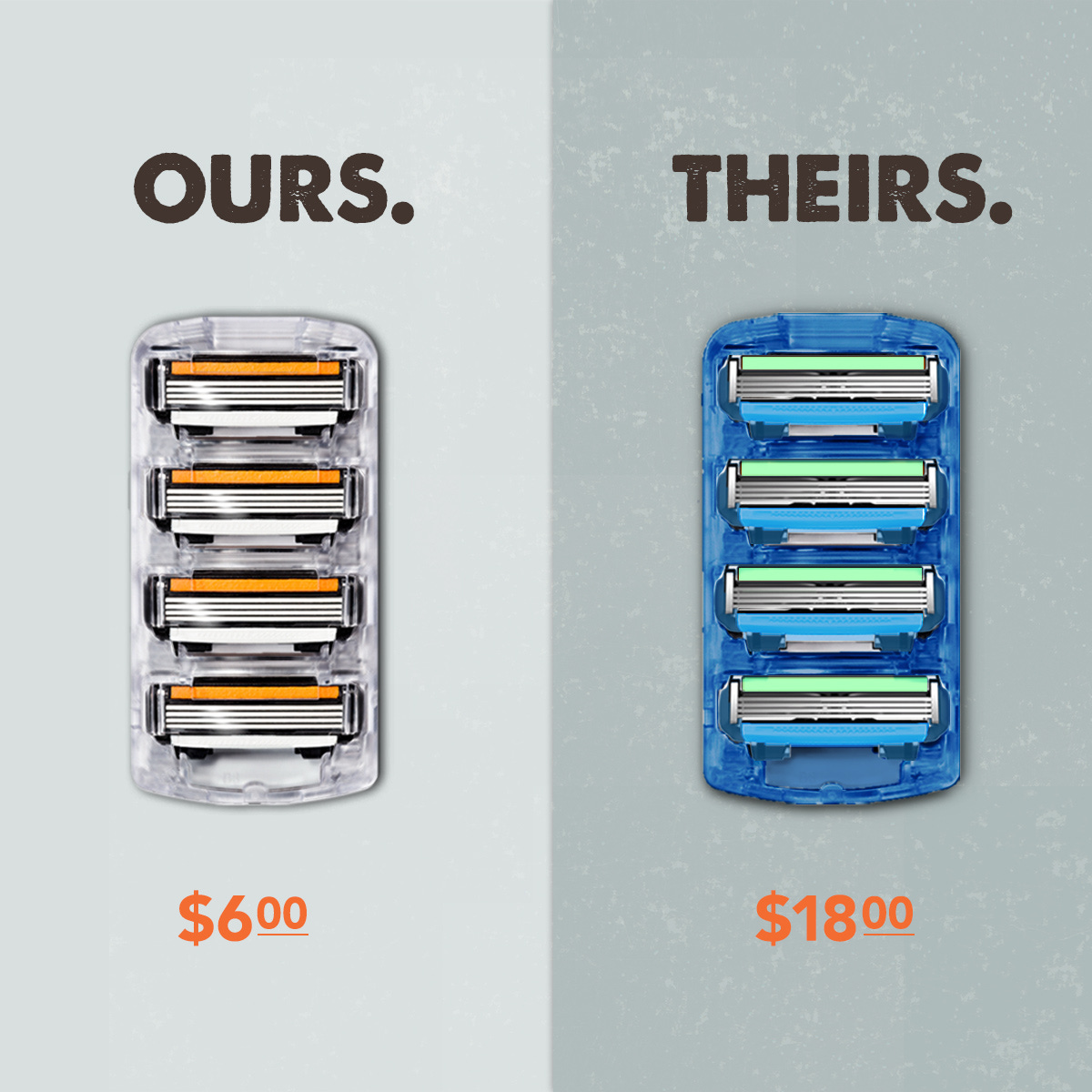
Gillette finally capitulated in the spring of 2017; it cut prices by an average of 12 percent. “You told us our blades can be too expensive and we listened,” Gillette admitted on its website. As Buffett famously explained, a strong moat provides pricing power. “If you’ve got the power to raise prices without losing business to a competitor, you’ve got a very good business.” This described Gillette very well, prior to the internet; throughout the 2010’s, however, the moat has eroded to a point that forced Gillette to “listen to its customers” and reduce prices.
Warren Buffett was no longer a Gillette shareholder when all this unfolded; he exited when Gillette was sold to Procter & Gamble for $57B in 2005. Dollar Shave Club itself was acquired by Unilever in 2016 for $1B. From zero to a billion in less than six years is exceptional! But at the same time, significantly less than Gillette’s $57B acquisition a decade earlier.
In hindsight, Dollar Shave Club did manage to blow up Gillette’s moat, but failed to capture the majority of the value it unlocked; that value – as Ben Thompson beautifully explained when he wrote about Harry’s Razors – accrued mostly to Google and Facebook.
It’s fascinating how these internet innovations have, arguably, changed how people shave. Or at the very least, it changed how enough people buy shaving products. And transformed the value chain of that industry.
In Buffett’s defense, no one could have predicted, back in 1998, how things like social networks and e-commerce were going to come together and affect the shaving market; probably not even his friend Bill Gates, who was sitting next to him on stage at that University of Washington event referenced above, having just defeated Netscape in the browser wars during that very same summer.
Revolutionary technologies develop through S-curves that are often messy and impossible to predict; that was the topic of the second post I have published in this blog. The topic of the first post, incidentally, was that Warren Buffett – whom I consider to be one of the best business analysts in history, and have personally learned so much from – had a blind spot when it comes to Disruption Theory (which is why it’s crucial for one to complement their study of Buffett with a subscription to Stratechery!). These two themes come together so perfectly in this case, of how Buffett’s confident prediction that the internet was not going to affect Gillette, turned out to be so incredibly wrong, which makes it into one of my favorite “Buffett’s Mistakes” stories.
Warren Buffett had famously mitigated his disruption blind spot by – going back to his quote above – staying away from unpredictable tech stocks, and focusing on “things the internet wasn’t going to affect”. Like gum-chewing or shaving. Except that the internet, eventually, and surprisingly—did disrupt the shaving market.
The key lesson concerns, naturally, AI; in an environment where – very much like 1998 and the internet – stocks soar or crash daily based on being labeled as AI winners or AI losers, Buffett’s wrong internet prediction serves as a humbling reminder. The real impact of AI could (a) take 10 or 15 years to play out in some industries, and (b) develop in surprising ways that are impossible to predict in advance. Even if you’re as good a business analyst as Warren Buffett, and even if you’re best friends with the founder and CEO of the most dominant tech company in the world, as Bill Gates surely was in 1998.
Not only is it impossible to predict how AI is going to transform the tech industry, it’s probably impossible to predict which industries are immune to being affected by AI. Perhaps it might somehow change how people chew gum.
The above is for educational purposes only; not investment advice. I am not an investment advisor, these are just my opinions and thoughts.
It was named this way because Procter & Gamble (P&G) has so masterfully and successfully executed on a similar strategy, but it generally applies to other successful consumer packaged goods (CPG) companies of the pre-internet era, such as Gillette. That’s also what made Gillette into such a perfect acquisition target for P&G in 2005.
Youtube actually launched in December of 2005, to be exact. It was acquired by Google in 2006.
I love these stories. This post reminded me of Kodak's attitude towards digital photography.